Activity date: 29 September 2026 · Hotel Royal Tulip, Gwarko, Lalitpur
The Rotary Club of Patan and the Nepal NCD Alliance marked World Heart Day 2026 with an awareness and prevention programme under the theme “Don’t Miss a Beat”. Participants included Rotarians, Rotaractors, Inner Wheel members and representatives of health organisations.
District Governor Rtn. Vishnu Bahadur Karkee was chief guest. Expert speakers were:
Rtn. Dr. Prakash Raj Regmi, President, Nepal NCD Alliance, who also coordinated the programme
Dr. Abhinav Baidhya, President, Southeast Asia Regional NCD Alliance
Dr. Abani Bhusan Upadhyaya, Senior Consultant Cardiologist
Dr. Bhagwan Koirala, Chair, Kathmandu Institute of Child Health
Dr. Chandra Mani Adhikari, Coordinator, Nepal Heart Net and President, Cardiac Society of Nepal
Thank you to the speakers, partners, members and everyone who attended.
Activity dates: from 27 July 2026, graduation 5 August 2026 · Kushadevi, Panauti Municipality-2, Kavrepalanchowk
Fifteen persons with disabilities took part in the fourth batch of mushroom-cultivation training under the STAR Project, held at Shree Patikhoriya Agriculture Co-operative, Kushadevi. According to the club’s activity report, all 15 completed the ten-day course and graduated on 5 August 2026.
The training covered practical mushroom cultivation, livelihood skills, self-employment and entrepreneurship.
Implementing partner: Ability Development Society of Nepal (ADSoN)
Supporters: The Rose International Fund for Children (TRIFC) and the Rotary Club of Patan through its KPAD disability-inclusion fund
Completing training is an important first step. Lasting income depends on participants applying their skills, with continued support and follow-up. We will report follow-up results where they are available.
Sources: STAR Project 4th batch entry, Rotary District 3292 project register, 2026–27; club activity report on the 4th batch graduation, August 2026.
https://rotaryclubpatan.org.np/wp-content/uploads/2018/08/imageedit_3_9112703088-300x119.png00Shiv Prakash Khemkahttps://rotaryclubpatan.org.np/wp-content/uploads/2018/08/imageedit_3_9112703088-300x119.pngShiv Prakash Khemka2026-10-15 03:34:102026-10-15 03:34:11STAR: fourth batch of mushroom-cultivation training in Kushadevi, Panauti
Activity date: 26 August 2026 · Paathsala Nepal Foundation School, Bagdol, Lalitpur
As part of the END RHD Campaign Nepal, the Rotary Club of Patan and the Nepal Heart Foundation held a heart-screening programme for schoolchildren at Paathsala Nepal Foundation School.
825 children had a first check with a stethoscope for abnormal heart sounds and murmurs.
34 students with suspected abnormal murmurs were then assessed with portable echocardiography by a medical team led by Prof. Dr. Prakash Raj Regmi.
According to the screening report, no definite cardiac cases were diagnosed at the event.
The programme aimed to bring early detection of rheumatic heart disease into the school setting and to raise awareness among children. It is part of the club’s long-running work with the Nepal Heart Foundation.
Thank you to the medical team, the school and everyone who supported the programme.
Source: club project report, END RHD Campaign Nepal, Rotary District 3292 project register, 2026–27.
https://rotaryclubpatan.org.np/wp-content/uploads/2018/08/imageedit_3_9112703088-300x119.png00Shiv Prakash Khemkahttps://rotaryclubpatan.org.np/wp-content/uploads/2018/08/imageedit_3_9112703088-300x119.pngShiv Prakash Khemka2026-10-15 03:32:412026-10-15 03:32:42Heart screening reaches 825 children at Paathsala School
On Friday, 10 July 2026, the Rotary Club of Patan and Heart Club Nepal held an essay competition on Heart Health and Community Service for students of the 24 public schools supported through the club’s PEEF scholarship programme. It aimed to help young people think about healthy lifestyles, preventing heart disease and the value of community service.
How it worked
Each school was invited to nominate two students from grades 9–10, preferably one girl and one boy. 37 students took part.
Five themes were shared in advance: Healthy Lifestyle, Healthy Heart; My Role in Preventing Heart Diseases; Junk Foods – Taste Good but Damage Your Health; Don’t Damage Your Heart with Vaping (E-cigarette); and Rotary Clubs and Community Services. Students drew their topic by lottery and had one hour to write.
Tri-Padma School, Pulchowk, Lalitpur hosted the competition. The club provided writing materials, refreshments and transport support.
Essays were marked anonymously by code number against a 100-mark rubric covering relevance, content, organisation, language and originality. Eight were shortlisted. Dr. Ganga Ram Gautam reviewed the shortlist and proposed the ranking, which a committee endorsed on 10 August 2026: Rtn. Mahendra S. Rawal, Rtn. Nirmal K. Pradhanang, Rtn. Lalita C. Thapa and Mr. Dev Bir Basnet of Heart Club Nepal.
Results
First: Sushmita Syangtan, Shree Udayakharka Secondary School
These are students’ own essays, summarised here. They are student writing, not medical advice.
Sushmita Syangtan (first, in Nepali) wrote on Rotary clubs and their role in the community. The essay describes Rotary’s work in education, health, the environment and disaster relief, and how scholarship support helped the writer continue studying and aim higher.
Kyarol B.K. (second, in English) wrote “My Role in Preventing Heart Diseases”. The essay argues that heart disease is not only a problem of old age, warns young people about vaping, smoking, alcohol and junk food, and calls on families and communities to set healthy examples.
Chandra Sunar (third, in Nepali) wrote on junk food: tasty but harmful. The essay urges home-cooked food, limits on junk food in schools, and shared responsibility for healthy eating.
Rtn. Mahendra S. Rawal coordinated with the participating and host schools. Rtn. Khadak S. Bisht, Dr. Ganga Ram Gautam, Rtn. Lalita C. Thapa, Rtn. Nirmal K. Pradhanang, Dr. Prakash R. Regmi and Rtn. Shiv Prakash Khemka also helped with planning, coordination, evaluation and programme support.
Adapted from Bhawana Lama Moktan’s contribution, “A Personal Journey Through Rotary Club of Patan”, in Lalitdhara Souvenir Vol. 41 (p. 69). This is her personal experience; the programme details that follow her story describe PEEF more generally.
Bhawana was a Grade 7 student at Shree Krishna Secondary School when the Rotary Club of Patan visited and interviewed students for PEEF scholarships. “What began with a simple hope of receiving a scholarship gradually turned into an opportunity that changed my life, built my confidence, and opened doors I never thought would be possible for me.”
“Rotary’s support gave me the motivation to work harder and take my education seriously.” In Grade 9 she won first position in the Kamalmani Educational Excellence Award (KEEA). “I still remember seeing the happiness and pride on my father’s face.”
After the SEE, she went through a selection and interview process, supported and encouraged by a Rotary mentor, and was offered a full scholarship to study Grades 11 and 12 at Ullens School. She was nervous at first, but found the students and teachers friendly and supportive. Projects, presentations and a research assignment in Grade 11 helped a once-shy student grow in confidence: “I still get nervous sometimes, but I can clearly see how much I have grown since Grade 7.”
When she wrote her article, Bhawana was a Grade 12 student at Ullens School.
“My journey with Rotary has taught me that sometimes, one opportunity is all a student needs to discover how far they can go.” — Bhawana Lama Moktan
About PEEF
PEEF connects school scholarships with further opportunities: KEEA recognises academic achievement, selected students may receive full scholarships at Ullens School, and GSSA supports eligible students in higher education. These opportunities have their own selection criteria; students do not necessarily progress through all of them. Learn more about PEEF.
The Rotary Club of Patan has completed the 2026 scholarship distribution of the Prajapati Education Endowment Fund (PEEF), the club’s flagship education programme since 1991.
374 students supported this year
24 public schools in Lalitpur
NRs 22,21,000 total distribution (grades 7–10: NRs 18,29,000; grades 11–12: NRs 3,50,000; payments to non-selected students: NRs 42,000)
234 girls (63%) and 140 boys (37%)
Source: PEEF selection and distribution completion update, 11 October 2026.
As of 16 July 2026, the total PEEF fund stood at NRs 2,48,71,233, made up of the Trust Fund (NRs 1,79,61,136) and the Programme Fund (NRs 69,10,097).
Thank you to every member, family and supporter who made this year’s distribution possible. Read more about the programme on the PEEF page, or make a pledge to support next year’s students.
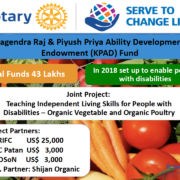
The Rotary Club of Patan (RCP) has a long history of support to people with disability, including the successful completion of the 3H grant project (2008-2012) to raise awareness in this regard. In September 2018, with an initial pledge of NRs. 10 Lakhs by Rtn. Rabendra Raj Pandey, the RCP established, in his parents’ name, ‘Khagendra Raj and Piyush Priya Ability Development Endowment Fund’ (KPAD).
Highlights of the KPAD Programme:
RCP KPAD Fund was established with a long-term vision to enable people with disabilities.
The RCP family committed to take ownership of this flagship programme through advocacy for fund-raising and voluntary contributions by a maximum number of the RCP family.
Within three months of its establishment, the RCP raised over NRs. 25 Lakh (2.5 million) and set its aim to raise NRs. 1 crore (10 million) within 3 years.
All interest from the KPAD Trust Fund is deposited into a Programme Fund, 100% of which will be used to support programmes for people with disabilities. All the professional time and resources provided by the RCP family to manage this programme are voluntary.
First support from the KPAD funds was made in December 2019 to the Karnali secondary school’s 20 visually impaired students with supplies worth NRs. 32,500.
2020-2021 Activities:
Representatives of the RCP KPAD committee have been working to start a sustainable project to support people with disabilities. A five-year ‘Project Cooperation Agreement’ has already been signed in April 2021 between three project partners (the Rose International Fund for Children (TRIFC) – USA Non-profit (NGO); Ability Development Society of Nepal (ADSoN) – Nepal NGO; and the Rotary Club of Patan). The project is called ‘Empowering People with Disabilities in Nepal by Teaching Organic Vegetable and Poultry Farming Skills’. A Memorandum of Understanding (MOU) is in the final stage of preparation with the implementing partner ‘Shijan Organic Pvt. Ltd., Nepal’.
Learning how to grow organic vegetables and raise organic poultry are skills which can help lift people with disabilities (PwD’s) in Nepal by instilling the values of life-long learning, cooperation, cross-disability interaction, helping others and dignity, all the while learning and earning. This project will hire and train PwD’s from all different disability areas who will in turn teach other PwD’s through a 3-month vocational training course designed to be disability accessible and inclusive. Programme graduates will be prepared and qualified to start their own farming enterprise with the option of joining a cooperative to help market and sell their products. Some graduates may choose to start their own garden area in their own home to grow vegetables and poultry for their family to consume. Follow up help and support will be provided as needed. Whatever the programme graduates choose to do with their farming knowledge, they will have learned valuable skills that will empower, improve self-esteem, and be greatly valued by their families.
The project will establish a disability-friendly, inclusive organic farm on a parcel of leased farmland in the Kathmandu valley to provide for the economic sustainability and improved nutritional health of people with disabilities. The project partners will undertake their activities through its implementing partner after receiving extensive advice and counsel from organic farming experts, marketing experts and organizations supporting people with disabilities.
https://rotaryclubpatan.org.np/wp-content/uploads/2021/08/KPAD-4th-Club-Assembly-2021-22-Aug-29-Final-15-Aug.png720960Bijaya Mallapatyhttps://rotaryclubpatan.org.np/wp-content/uploads/2018/08/imageedit_3_9112703088-300x119.pngBijaya Mallapaty2021-07-29 18:37:312026-10-14 10:52:04Khagendra Raj and Piyush Priya Ability Development Endowment Fund (KPAD)
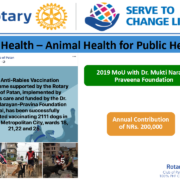
Background – In June 2019, the Rotary Club of Patan (RCP) signed a Memorandum of Understanding with the Dr. Mukti Narayan Praveena Foundation whereby the Foundation agreed to make an annual donation of NRs. 200,000 to the Rotary Club of Patan for its ‘Animal Welfare for Public Health’ programme in the Lalitpur District. During the Rotary Year 2019-2020, the Rotary Club of Patan collaborated with the NGO Sneha’s Care, conducting an anti-rabies vaccination programme in Nakhu, Bhainsepati, Khokana and Bungamati areas of Lalitpur. Between mid-March 2020 to mid-April 2020 the Sneha’s Care team was able to vaccinate 2111 dogs despite the difficulties faced during the COVID-19 pandemic lockdown.
One Health – The concept of ‘One Health’ approach was officially launched in September 2004 at the ‘One World, One Health – building interdisciplinary bridges to health in a globalized world’ conference in New York. This is a multi- sectoral and integrated approach for preventing and mitigating health threats at the Animal-Human-Plant-Environment interfaces with the objective of achieving public health, food and nutrition security, sustainable ecosystems, and fair-trade facilitation. The ‘One Health’ approach has been adopted worldwide for cross-sectoral and multi-disciplinary collaborations to effectively deal with the endemic, emerging, infectious, and zoonotic diseases.
Zoonotic Diseases – Zoonotic diseases, also known as zoonoses, are those diseases and infections that are caused by germs/ microorganisms that spread from vertebrate animals to humans and vice versa. There are three classes: a) endemic zoonoses – which are present in many places and affect many people and animals; b) epidemic zoonoses – which are sporadic in temporal (time) and spatial (place) distribution; and c) emerging and re-emerging zoonoses – which are newly appearing in a population or have existed previously but are rapidly increasing in incidence or geographical range.
Global, Regional and National Context – The health threats of emerging and re-emerging diseases including zoonoses at the animal-human-plant- environment interfaces are becoming more prominen and frequent. SARS-CoV-1, avian influenza, rabies, Nipah and Ebola outbreaks, as well as food-borne diseases and antimicrobial resistance (AMR), continue to have major impacts on our health, livelihoods, and economies. The current global pandemic of SARS-CoV-2 virus (COVID-19) makes it clear what devastating effects zoonotic disease can have.
In recognition of the global threat that the Highly Pathogenic Avian Influenza (HPAI H5N1) outbreak in 2003/2004 in Asia and other emerging zoonotic diseases posed, the Food and Agriculture Organization (FAO), World Health Organization (WHO), and World Organization for Animal Health (OIE) developed a strategic framework and a tripartite agreement, to work more closely locally, nationally, and globally, to attain optimal health for people, animals and our environment.
‘One Health’ challenges and benefits – With rapid population growth, globalization and environmental degradation, health threats have become more complex. Solutions cannot be found by one sector alone. The ‘One Health’ approach leverages the idea that problems impacting human, animals, plants, and environmental health can be effectively resolved through improved coordination, communication, and collaborative actions across disciplines.
Specific intervention, such as rabies vaccination programmes; knowledge management; awareness raising; advocacy to garner political commitment; collaboration among all stakeholders within the ‘One Health’ approach contribute to consistent and synergetic decision-making, avoidance of gaps and duplication of effort. The multi- sectoral coordinated approach has been proven as a successful tool for managing public health risk with zoonotic potential.
Rotary Club of Patan’s plans – The RCP ‘One Health’ team is exploring on broadening its work in the ‘One Health – Animal health for Public Health’ area this Rotary Year. The team is reviewing how the RCP could get involved in the multi-sector collaborative rabies eradication project to achieve an even larger impact. The Rotary Club of Patan ‘One Health’ team members are: Rtns. Mukti N. Shrestha, Khadak S. Bisht, Gabriele Mallapaty, Bijaya Mallapaty (Service Project Chair), and Nirmal Pradhanang (President).
https://rotaryclubpatan.org.np/wp-content/uploads/2021/08/One-Health-–-Animal-Health.png720960Bijaya Mallapatyhttps://rotaryclubpatan.org.np/wp-content/uploads/2018/08/imageedit_3_9112703088-300x119.pngBijaya Mallapaty2021-04-29 18:55:312026-10-14 10:52:20One Health – Animal Health for Public Health
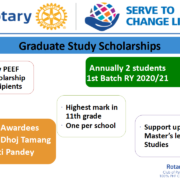
The RCP GSSA was established in December 2018 to support two students from among the PEEF scholarship recipients for college studies (up to 6 years) till the completion of master’s level education. The scholarship grants would start from 2020. With the addition of 2 students each year, scholarships would be given to 12 students each year by the 6th year.
https://rotaryclubpatan.org.np/wp-content/uploads/2021/08/Graduate-Study-Scholarships.png720960Bijaya Mallapatyhttps://rotaryclubpatan.org.np/wp-content/uploads/2018/08/imageedit_3_9112703088-300x119.pngBijaya Mallapaty2021-03-29 19:03:242026-10-14 10:52:35Graduate Studies Scholarship Award (GSSA)
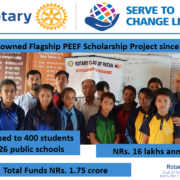
The Rotary Club of Patan has been implementing the Prajapati Education Endowment Fund (PEEF) programme providing educational scholarship to needy children in public schools since 1991. The programme has demonstrated that the value of a small monetary contribution is exponentially larger in terms of improvements of a child’s overall well being and potential to develop communities through continued education.
Through this flagship programme, the Rotary Club of Patan has provided scholarship support to some 2750 students of 27 public schools of Lalitpur District. Initially scholarships were provided from grades 6 to 10, which has now been revised to grades 7 to 12. As of 31 January 2019, the PEEF Trust Fund has reached Nepalese Rupees 12.47 million with available programme funds of 2.7 million.
The Rotary Club of Patan established a PEEF Management and Operational Policies that governs this programme. These policies outline the funds’ management, criteria for support, investments and financial management mechanisms, and administrative responsibilities. The Trust Fund is securely invested, while interest earned in the Trust Fund and contributions to the programme funds are used to provide annual scholarships.
A key to the continued success of this flagship programme of the RCP is that the entire RCP family takes ownership of it. In addition to a dedicated committee managing this programme, the RCP family volunteers its valuable time and resources during the annual student selection and funds distribution in the assisted schools throughout the Lalitpur District. This ownership and support ensure that PEEF continue to operate entirely by volunteers from the RCP family with zero administrative cost.
The Rotary Club of Patan appreciates the contributions and continued support from all its donors and well-wishers. RCP Members, their families, relatives, friends and other well-wishers are among the contributors of this programme.
Continuous Improvement
In March 2016, the year of PEEF’s 25th anniversary, the RCP conducted a situation analysis of this programme, reviewing its successes, strengths, and challenges. It pointed out that a long-term mechanism was needed to deal with the PEEF’s dependence on fluctuating interest rates and that reporting to its expanding donor base needed to be simplified. The programme fund had been decreasing due to reduced interest rates while the scholarship amounts needed to support students had been increasing due to continuing inflation.
Feedback from all members confirmed that the scholarships provided were highly appreciated by the students and that they helped needy students in continuing their education. Subsequently, the Rotary Club of Patan institutionalized several changes in the management of the PEEF.
Towards qualitative support of a student, the Rotary Club of Patan gradually increased the annual scholarship amount, while reducing the number of students and schools supported based on affordability. This year, the scholarship amount per student in grades 7 to 10 was increased from NRs. 2,000 to NRs. 3,000, with an additional NR. 1,000 given to meritorious students obtaining 70% (B+) or more marks in their final prior year examination. From grades 11, students receive NRs. 5,000 per year.
Latest Developments
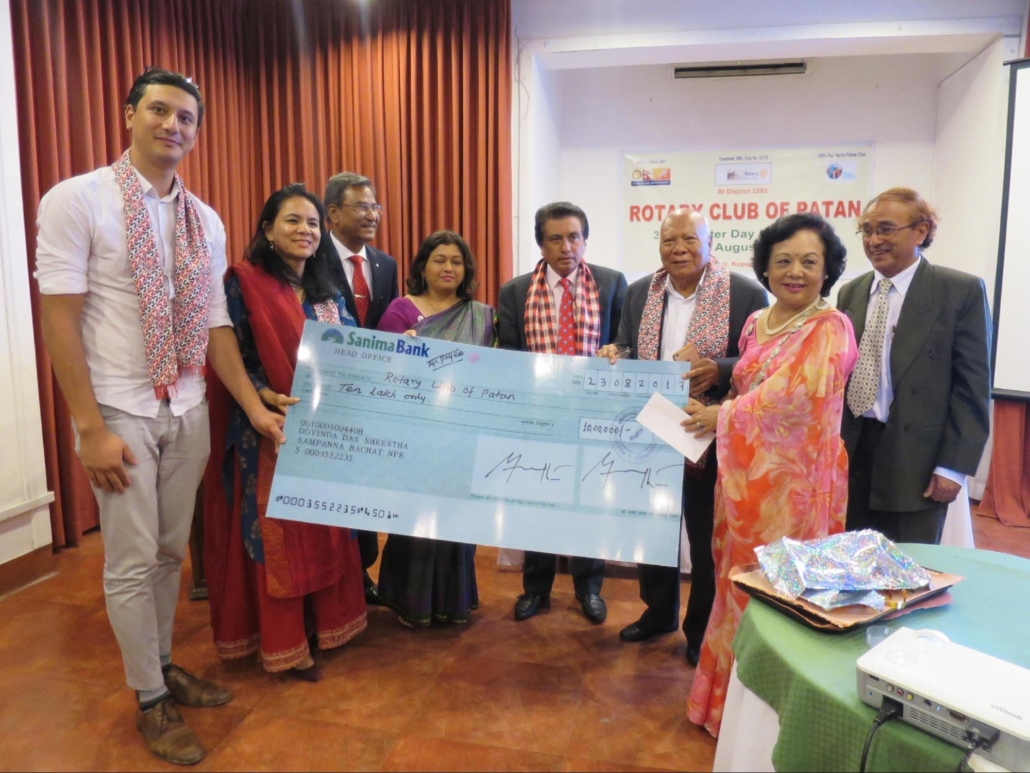
In August 2017, President of Sarswati Govinda Foundation, late Rtn. Govinda Das Shrestha contributed one million Nepalese Rupees to the PEEF, and subsequently signed a MOU with the Rotary Club of Patan pledging to contribute this amount annually. In the history of Rotary in Nepal, this is the largest long-term commitment of annual contribution made by a Nepali through a Rotary Club in Nepal, and the RCP is proud of this trust bestowed upon it.
With the inclusion of grades 11 and 12 in secondary education system in Nepal, and the expansion of its donor base, the RCP is providing scholarship support to continuing grade 11 students and will continue this support to grade 12 from the coming school year.
During Rotary Year 2018/2019, 395 public school students from lower-income families in 27 schools of Lalitpur District received scholarships totalling NRs. 1,178,000 to support their education.
Complimentary Activities
The Rotary Club of Patan established the ‘Kamalmani Educational Excellence Award’ (KEEA) to meritorious students receiving PEEF scholarships in 2013 with the initial sponsorship of late Rtn. Kamalmani Dixit. The award fund has since been expanded with annual support from several other members of the RCP. The KEEA currently recognizes top ten meritorious students in grade nine from among the PEEF scholarship recipients with certificates and cash awards. The award amount totals NRs. 100,000 annually and includes NRs. 25,000 to the first, NRs. 15,000 to three second, and NRs. 5,000 to six third best students.
In December 2018, the ‘Rotary Club of Patan Graduate Studies Scholarship Award’ was established with the initiation of Rtn. Matsyendra L. Kayastha and support of Rtn. Prakash R. Regmi. Starting in 2020, this award amounting to NRs. 14,000 per year for up to six years will be given to two students from among the PEEF scholarship recipients for college studies till the master’s level. Since each year, two students will be added, in six years, Rotary Club of Patan will be awarding 12 students every year for master’s level studies.
Conclusion
The RCP is committed to continue the PEEF programme to suit the evolving context of the public education system in Nepal with its principal mandate to support public school students from lower-income families to improve their education.
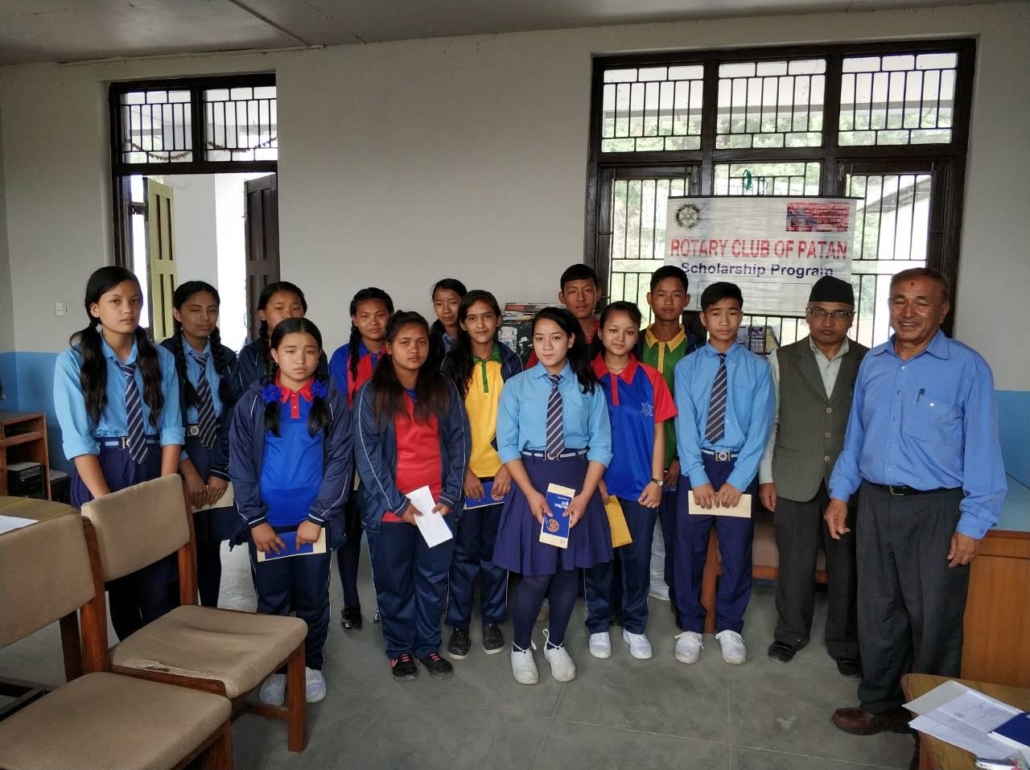
Example of a group of students in a school supported by the PEEF (Shree Krishna HSS Dhapakhel) after receiving their scholarship funds with the RCP representatives.
At the KEEA awards ceremony, the first prize-winner, Ms. Samdoma Sherpa, made an outstanding speech thanking the RCP and all the sponsors of the PEEF and KEEA, on behalf of all PEEF-supported schools and recipients of KEEA. She represented all the students when she spoke about how grateful they have been for the recognitions. She cited her own example as a success story – coming from illiterate and economically poor but determined parents who facilitated all their five daughters’ education, she mentioned that the RCP support has been truly inspirational and has indeed changed her life.
President of Sarswati Govinda Foundation Mr. Govinda Das Shrestha (3rd from left) handing over the cheque of Nepalese Rupees one million to the President of the Rotary Club of Patan in the presence of his family, District Governor of Rotary and other RCP officials.
https://rotaryclubpatan.org.np/wp-content/uploads/2020/05/4th-Club-Assembly-2021-22-Aug-29-Final-15-Aug.png720960Bijaya Mallapatyhttps://rotaryclubpatan.org.np/wp-content/uploads/2018/08/imageedit_3_9112703088-300x119.pngBijaya Mallapaty2020-05-08 09:39:042026-10-14 10:53:13Prajapati Education Endowment Fund (PEEF)